SteadySleep
Multi-source data integration and ML for dysautonomia detection — wearables and medical devices onto a single timeline.
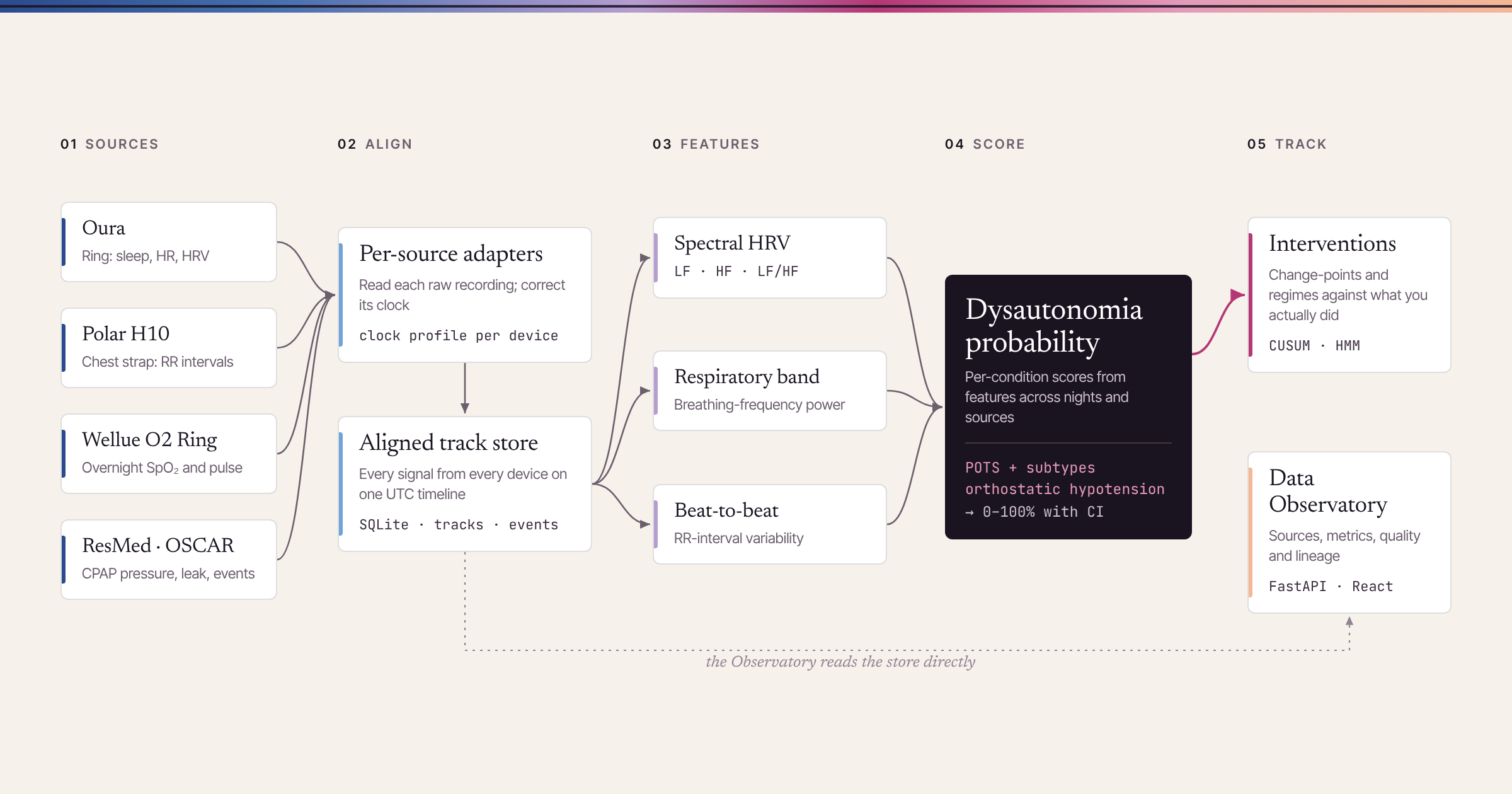
SteadySleep is the data-integration spine for the dysautonomia work. At the bottom sits an aligned-track store — every signal from every device on a single UTC timeline. Per-source adapters under `data_layer/adapters/` materialize raw recordings into the store with a clock correction applied per recording, so multi-device alignment isn't a coin toss.
On top of that store, ML models estimate the probability of various autonomic-nervous-system disorders — POTS, orthostatic hypotension, related dysautonomia subtypes — from physiological feature streams aggregated across sources.
Spectral analysis of continuous cardio biomarkers feeds the models: frequency-domain HRV (LF / HF), respiratory-band power, and beat-to-beat variability give the autonomic-state signal underneath the symptoms.
The system also tracks symptoms against interventions over time, so changes in autonomic balance can be correlated with what the user actually did — and you can tell whether a protocol change is doing anything within weeks rather than seasons.